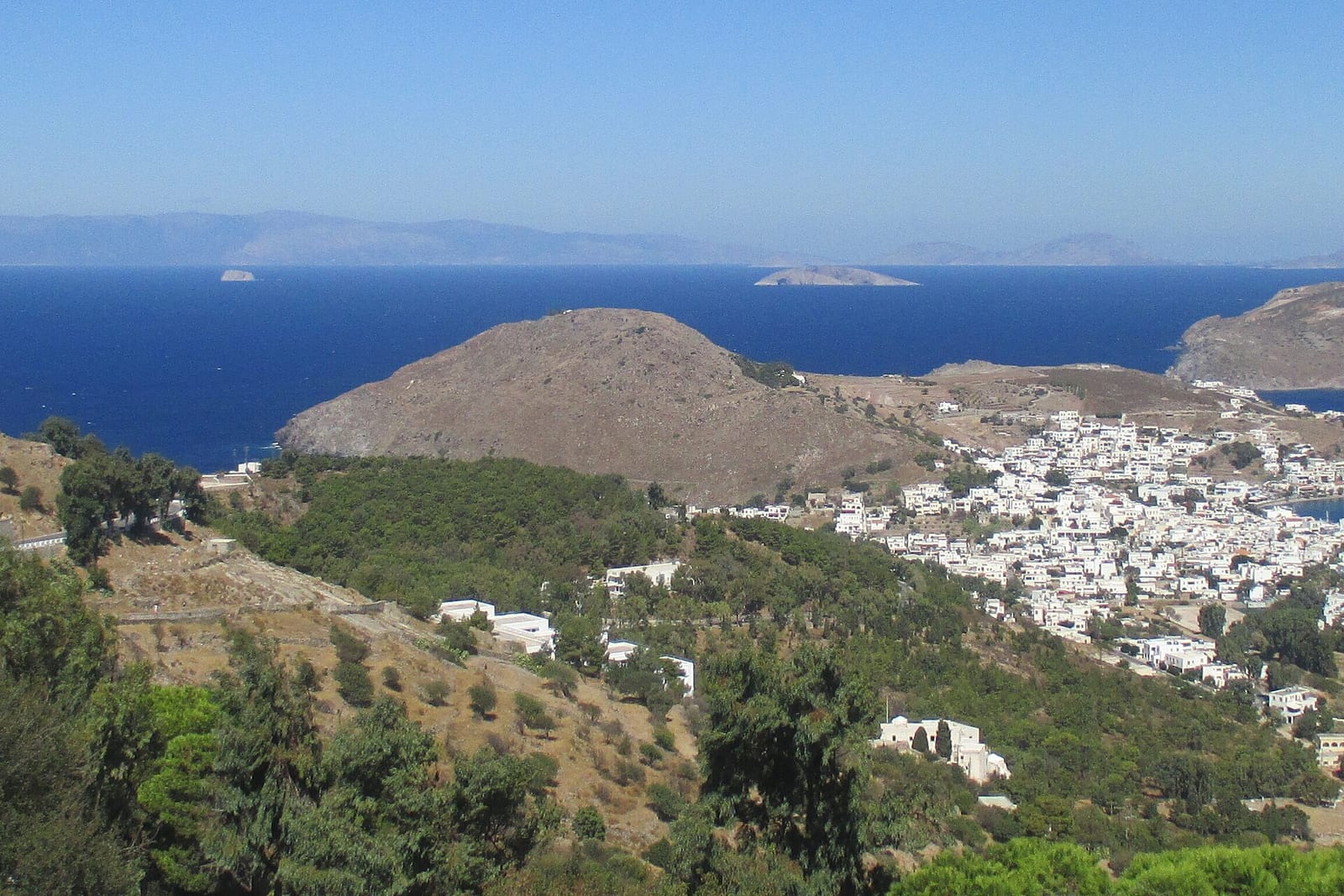
Patmos has no airport and is reached only by ferry, built around the Monastery of Saint John above Chora and the cave where John is said to have received his visions. It suits travelers drawn to religious history and understated whitewashed architecture over beach clubs or nightlife.
- Main port
- Skala
- Recommended nights
- 2–3
- Best time to visit
- May, Jun, Sep
- Wind & disruption risk
- Moderate
Known for
- Monastery of Saint John the Theologian
- Cave of the Apocalypse
- Chora old town
- Psili Ammos beach
Getting there
Patmos has no airport, so arrival is by ferry into Skala, a small port about 4 kilometers below Chora. Fast catamarans connect south to Kos in under two hours and on to Kalymnos, making Patmos workable as a stop on a north-south Dodecanese run rather than an isolated add-on. Because it sits at the northern edge of the group, most routes reach it from Kos rather than directly from Rhodes.
When to go
Patmos carries a moderate wind risk, and the open crossing from Kos can get choppy during the meltemi months of July and August. Best months are May, June, and September, when the crossing is calmer and cruise ship crowds at the monastery thin out. Like the rest of the Dodecanese, the sailing season here runs longer than in the Cyclades, with workable connections into early autumn.
Where to stay
Skala keeps you at the port, with the most restaurants and the easiest ferry access, useful if you are moving on quickly. Chora, up by the monastery, is quieter and architecturally the more interesting base, all whitewashed walls and narrow lanes, though evenings there are noticeably subdued. Grikos, a small bay south of Skala, adds a beach option for travelers who want to stay near the water rather than in town.
Good to know
There is no real public bus network beyond a few daily routes, so many visitors walk between Skala and Chora or take a taxi. Cash is still expected in smaller Chora tavernas. Cruise ships call regularly in season and send crowds up to the monastery and cave by mid-morning, so an early visit avoids the crush. Cover shoulders and knees to enter the Monastery of Saint John, enforced more strictly than on most islands.
Related itineraries
Frequently asked questions
How do I get from Athens to Patmos?
Patmos has no airport, so arrival is by ferry into Skala, a small port about 4 kilometers below Chora. Fast catamarans connect south to Kos in under two hours and on to Kalymnos, making Patmos workable as a stop on a north-south Dodecanese run rather than an isolated add-on. Because it sits at the northern edge of the group, most routes reach it from Kos rather than directly from Rhodes.
Recommended nights — Patmos?
Patmos earns 2 to 3 nights, enough for the monastery, the cave, and one beach day, and works as a link rather than a dead end since it connects on to both Kos and Kalymnos. Cruise-call mornings are the main scheduling risk to plan around, not ferry cancellations.
When to go — Patmos?
Patmos carries a moderate wind risk, and the open crossing from Kos can get choppy during the meltemi months of July and August. Best months are May, June, and September, when the crossing is calmer and cruise ship crowds at the monastery thin out. Like the rest of the Dodecanese, the sailing season here runs longer than in the Cyclades, with workable connections into early autumn.
Times, prices and frequencies are indicative and change by season and operator. Always confirm the live timetable before you book.