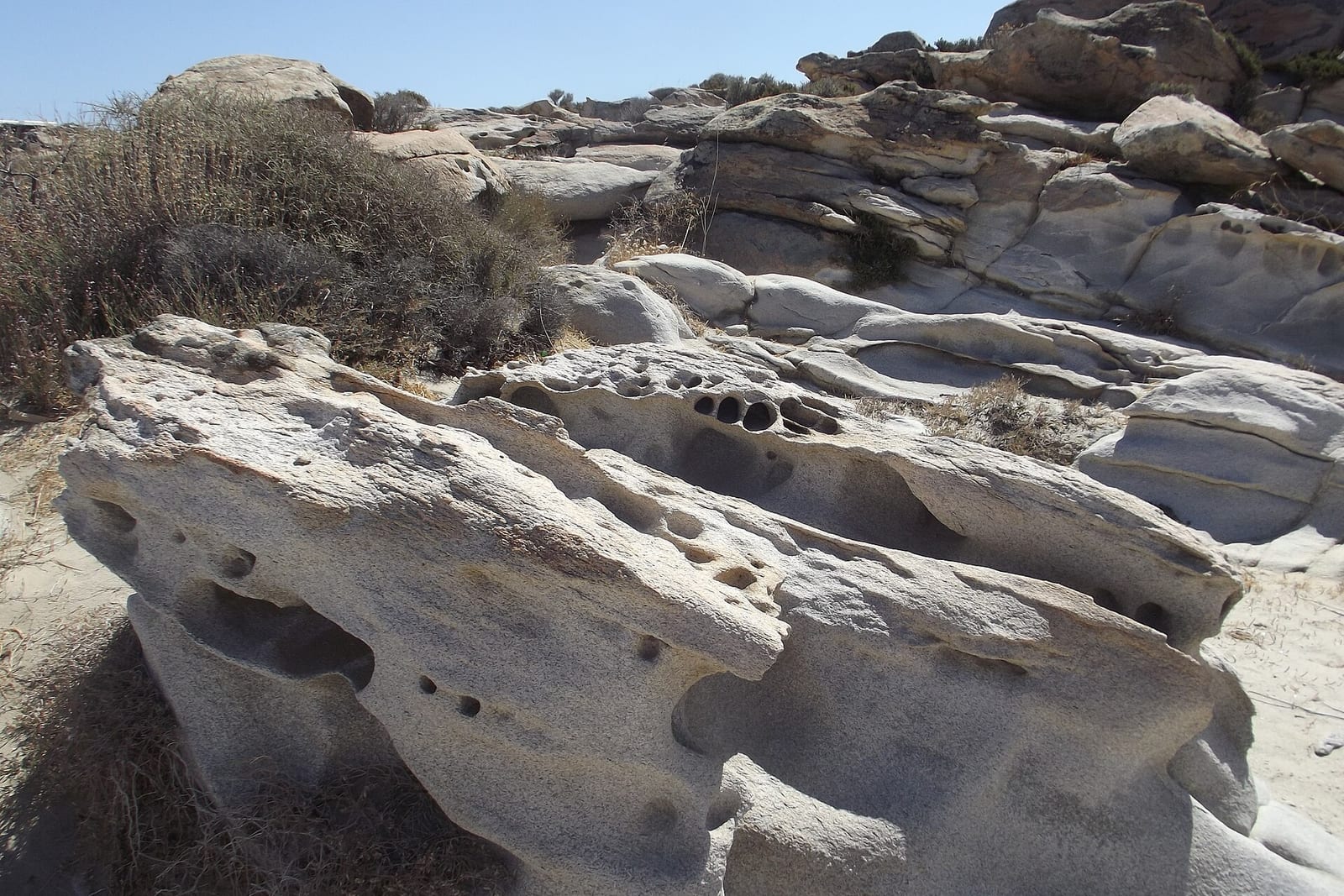
Paros is the practical middle of the Cyclades: large enough for two towns you would happily sleep in, small enough to circle in a day, and connected to nearly everything. Parikia handles the ferries and the traffic; Naoussa, on the north coast, is where you go for dinner. It suits travellers who want a base rather than a single destination.
- Main port
- Parikia
- Recommended nights
- 2–3
- Best time to visit
- May, Jun, Sep
- Wind & disruption risk
- Moderate
Known for
- The old fishing harbour at Naoussa
- Kolymbithres and Chrissi Akti beaches
- Panagia Ekatontapiliani, the fourth-century church in Parikia
- Lefkes and its Byzantine marble path
- The ancient marble quarries at Marathi
Getting there
Ferries dock at Parikia and the quay is the town, with the old windmill on the roundabout barely 200 metres from the ramp. Piraeus is 3 hours on the fast ferry, 4h 45m on the Blue Star. The airport is about 10 km south, near Aliki, and serves Athens only. If you are staying in Naoussa, note that it is 10 km north of the port, so an evening arrival still means a bus or a taxi at the far end.
Book the Athens–Paros ferryYou choose the direction and the sailing time when you book.
When to go
May, June and September. Wind risk here is moderate, worse than Naxos and better than Mykonos, and it is not incidental: the north coast is a serious kitesurfing centre precisely because the July and August meltemi blows through it, and fast ferries out of Parikia get pulled on the worst days. September is the single best month, with the sea at its warmest, Naoussa still fully staffed, and rooms well below their August peak.
Where to stay
Parikia is the cheapest base and the right one if you are moving on early, since everything sits minutes from the ramp. Naoussa, 10 km north, has the better harbour, the better restaurants and the higher prices. Chrissi Akti on the east coast is the wind and surf side, and it needs a car. Lefkes, inland, is a marble village that stays cool and quiet. Aliki, in the south, is calm and close to the airport.
Good to know
Buses run from the station beside the port in Parikia to Naoussa roughly every half hour in season, and around the rest of the island far less often, so plan on a car or an ATV for two days. Parikia's waterfront is a working port, which means ticket agencies, scooters and noise; book a room a street back. Cards are widely accepted and ATMs are plentiful in both towns. Parking in Naoussa in August is close to hopeless.
Related itineraries
Frequently asked questions
How do I get from Athens to Paros?
Ferries dock at Parikia and the quay is the town, with the old windmill on the roundabout barely 200 metres from the ramp. Piraeus is 3 hours on the fast ferry, 4h 45m on the Blue Star. The airport is about 10 km south, near Aliki, and serves Athens only. If you are staying in Naoussa, note that it is 10 km north of the port, so an evening arrival still means a bus or a taxi at the far end.
Recommended nights — Paros?
Two to three nights. Paros is a base, not a project, and the island itself is a day and a half of driving. It has the densest timetable of the six, with daily boats to Naxos, Mykonos, Santorini, Ios, Sifnos and Piraeus, making it the best place in a route to absorb a weather delay.
When to go — Paros?
May, June and September. Wind risk here is moderate, worse than Naxos and better than Mykonos, and it is not incidental: the north coast is a serious kitesurfing centre precisely because the July and August meltemi blows through it, and fast ferries out of Parikia get pulled on the worst days. September is the single best month, with the sea at its warmest, Naoussa still fully staffed, and rooms well below their August peak.
Times, prices and frequencies are indicative and change by season and operator. Always confirm the live timetable before you book.